
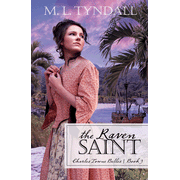
 Title: The Raven Saint
Author: M. L. Tyndall
Rating: Wall Target Practice (one star)
The Raven Saint is the story of Grace Westcott, an admiral’s daughter and the picture of virtue. She is kidnapped by Rafe Dubious, a French captain and mercenary. She struggles to discern God’s purpose in her kidnapping, especially since she has found herself among some of the worse heathens in the world. Captain Dubious believes that he is doing the right thing for kidnapping Grace, but as their voyage continues, he begins to doubt his motives.
This book has the potential to be good, but unfortunately disappoints on many different fronts. The first is the characters. Grace’s judgmental attitude actually becomes a turn-off by the fifth chapter. It was hard for me to care about her well-being. Captain Dubious is more likable, but his actions and motivations seem a little too unbelievable. His charity to people in need and his lust for revenge seem to conflict in the wrong way. I found myself more drawn to Madam Dubious’ servant, Annette, than the two main characters.
Second, the plot stalled in several places. There were portions where the plot didn’t move forward. The book also contained long sections of internal dialogue from one of the main characters. I found myself skimming often. Also, Grace seemed a bit too inactive. I understand she was a captive, but often it seemed like she was simply reacting to other’s actions. Another problem was a surprise plot twist at the end that didn’t resolve one of the subplots. It only left me with more questions.
Third, the actual writing left something to be desired. Some of the metaphors and similes sounded as if Tyndall was trying too hard. It was as if she tried to be unique but her attempts ended in some ridiculous sounding phrases. My personal favorite was “The liquor took a warm stroll down his throat...” I think simply saying the liquor warmed his throat would have been far more effective.
Also, there are complete sentences in French. It is not an uncommon occurrence to have foreign languages included to add to credibility, but it was excessive. In addition, there were several times were I couldn’t figure out what the sentence meant from context clues. I don’t speak French and I don’t think I should have to work to figure out what it means. Another issue I had with the writing is her overuse of words. I grew extremely weary of men “doffing” their hats and all the hat removing didn’t add anything to the story.
This book was an unfortunate disappointment, especially since it had potential to be a great story.


